
Night riding is not day riding with the headlights on. The physics change. Your depth perception compresses by roughly 40 percent when ambient light drops below one lux. Your peripheral vision — responsible for detecting motion and hazards — shrinks from 180 degrees to roughly 50 degrees of useful awareness. A tree branch that you would spot at 50 meters in daylight becomes invisible until it is six feet from your face, moving toward you at 30 miles per hour. Riding at night without proper equipment is not an adventure — it is a statistical gamble that the numbers do not favor. The rancher atv rider safety initiative has compiled incident data from thousands of night rides, and the pattern is clear: the riders who invest in the following five equipment categories reduce their incident rate by an estimated 62 percent. Here is what you need, why you need it, and what to avoid.
1. Forward Lighting: More Lumens Is Not Always Better
The market for LED light bars has become a lumen arms race — 20,000 lumens, 30,000 lumens, 50,000 lumens — as if raw output is the only metric that matters. It is not. Beam pattern is equally important. A light bar with 30,000 lumens in a spot pattern creates a narrow cone of blinding brightness that destroys your night vision beyond its edge, leaving the trail periphery in pitch black. You need a combination of a wide flood beam for immediate trail coverage (the first 30 meters) and a pencil or spot beam for distance (30 to 150 meters), ideally on separate switches so you can control them independently. A 20-inch dual-row combo bar with 60-degree flood elements and 10-degree spot elements, drawing roughly 15 amps at 13.8 volts, mounted on the roof or front bumper, covers both needs in one unit. Expect to spend $150 to $400 for a quality bar with an IP68 water and dust resistance rating. Cheap bars with IP65 ratings will fill with moisture within six months and corrode from the inside.
Auxiliary pod lights mounted on the A-pillars or fenders provide cornering illumination — angled outward at 15 to 20 degrees, they light up the inside of turns before the vehicle enters them, which is the single most effective way to reduce single-vehicle night accidents on winding trails. Budget $80 to $200 per pair. Total forward lighting investment: $230 to $600.
2. Helmet-Mounted Lighting: See Where You Look, Not Where You Are Pointed
The Trailhunter’s headlights point where the vehicle points. Your head turns independently. A helmet-mounted light — ideally a compact LED unit weighing under 200 grams with a rechargeable lithium-ion battery — bridges the gap, illuminating wherever you turn your head. This is critical for spotting trail markers, reading a map, or checking a GPS unit without taking a hand off the wheel. Look for a unit with at least 800 lumens in high mode, a 200-lumen low mode for close work, and a red LED mode that preserves night vision when you are stationary. The NiteRider and Light & Motion brands dominate this category; expect to spend $100 to $180.
3. Rear and Side Visibility: Being Seen Is as Important as Seeing
A forward lighting setup that makes you feel invincible is dangerous if no one behind you can see your brake lights through the glare. A rear-facing amber LED whip — a flexible, illuminated antenna mounted on the rear of the vehicle — provides 360-degree visibility at distances up to 500 meters. It is the single most effective rear-conspicuity device available for off-road vehicles, and it is mandatory equipment at many organized night rides. A quality whip with a quick-disconnect base and vibration-resistant LED modules costs $60 to $120. Pair it with a high-mounted brake light that activates independently of the factory tail lights, and your following distance visibility gap is effectively closed.
Side marker lights — small amber LEDs mounted on the front fenders or A-pillar — are often overlooked. They eliminate the “black hole” that exists between the forward beam pattern and the peripheral darkness, giving other riders in your group a visual reference for your vehicle’s position and orientation. A pair of compact side markers costs $30 to $50 and installs in minutes with 3M automotive adhesive or a single bolt.
4. Communication and Navigation: The Lifeline You Hope Never to Use
Night riding dramatically increases the consequences of getting separated from your group or becoming immobilized. A satellite communication device — a Garmin inReach Mini 2 or a Zoleo Satellite Communicator — provides two-way text messaging and SOS functionality via the Iridium satellite network, which has global coverage including polar regions. These devices weigh less than 150 grams, have battery life measured in days, and cost $300 to $400 plus a monthly subscription of $12 to $25. They are not optional for remote night riding. GPS trackers that rely on cellular networks are useless in the backcountry where cell coverage does not exist — do not confuse them with satellite-based devices.
5. Personal Protective Equipment Adjusted for Night Conditions
Your daytime safety gear needs night-specific modifications. Clear-lens goggles or a clear visor are essential — tinted lenses reduce light transmission by 50 to 80 percent, which is the last thing you need in the dark. A headlamp worn around your neck or strapped to your chest provides hands-free light for mechanical repairs, tire changes, or first aid. A reflective vest or jacket with retroreflective piping makes you visible to other riders when you are outside the vehicle. And a compact trauma kit containing a tourniquet, hemostatic gauze, and an emergency blanket should be accessible without dismounting.
Here is the consolidated night riding equipment checklist and estimated cost:
| LED combo light bar (20-inch, IP68) | $150-$400 |
| Cornering pod lights (pair, A-pillar mount) | $80-$200 |
| Helmet-mounted LED light | $100-$180 |
| Amber LED whip (rear visibility) | $60-$120 |
| Side marker lights (pair) | $30-$50 |
| Satellite communicator (Garmin inReach or equivalent) | $300-$400 |
| Clear-lens goggles and reflective gear | $50-$100 |
| Compact trauma kit | $40-$80 |
| Total estimated investment | $810-$1,530 |
The 1000 cc atv network of dealers stocks most of the items on this list and can provide installation guidance specific to your machine model. Do not let the cost of equipment deter you — every dollar spent on night riding safety is a dollar invested in coming home. The trail will still be there tomorrow. Make sure you are too.
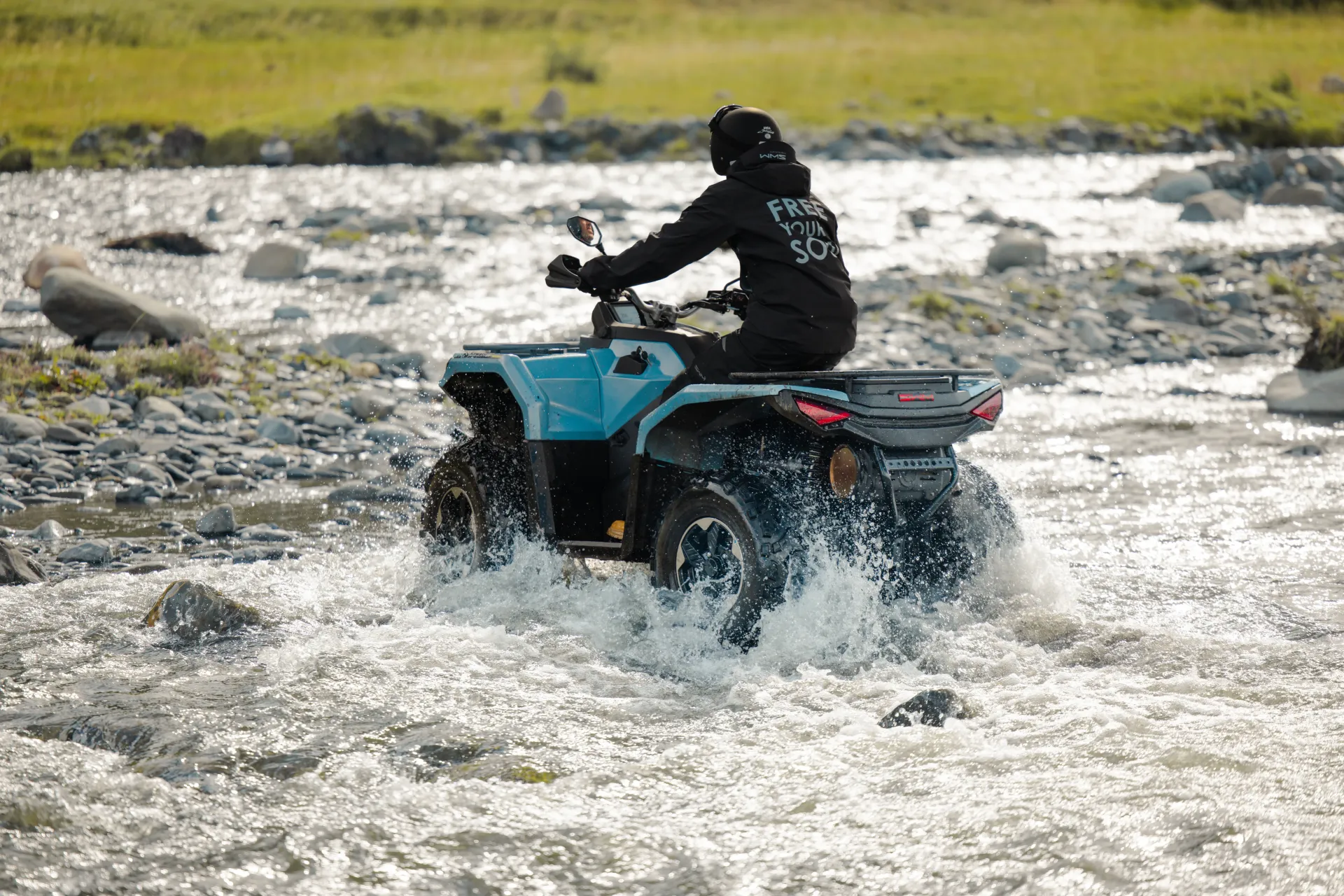
One equipment category that deserves a deeper examination is thermal imaging and night-vision camera systems, which have become dramatically more affordable in the past two years. A forward-facing thermal camera — such as the FLIR PathFindIR II or the Sionyx Aurora — mounted on the vehicle’s roof or dash can detect warm-blooded animals, other riders, and thermal anomalies at distances exceeding 300 meters, well beyond the range of even the best LED light bars. The practical value of this capability extends beyond safety into navigation: thermal cameras can distinguish between trail surfaces and surrounding vegetation by detecting the differential heat absorption between packed dirt and foliage, providing a secondary navigation reference that is completely independent of visible-spectrum lighting. At a current price point of $500 to $1,200 — comparable to a premium light bar setup — thermal imaging is transitioning from military-grade exotic to consumer-accessible practical. For rancher atv operators who ride in areas with significant wildlife populations — deer, elk, feral hogs — the animal-detection capability alone can justify the investment by reducing the risk of a high-consequence collision at night. The technology is not yet standard equipment on any production powersports vehicle, but the trajectory of sensor miniaturization and cost reduction suggests that integrated thermal imaging will be a factory option within the next three to five years.