
AI video production is the process of using artificial intelligence tools to help create videos from ideas, scripts, images, audio, or other digital content. Instead of completing every part of video creation manually, creators can use AI to assist with tasks such as writing scripts, generating visuals, creating voiceovers, editing footage, adding captions, and producing different versions of the same video.
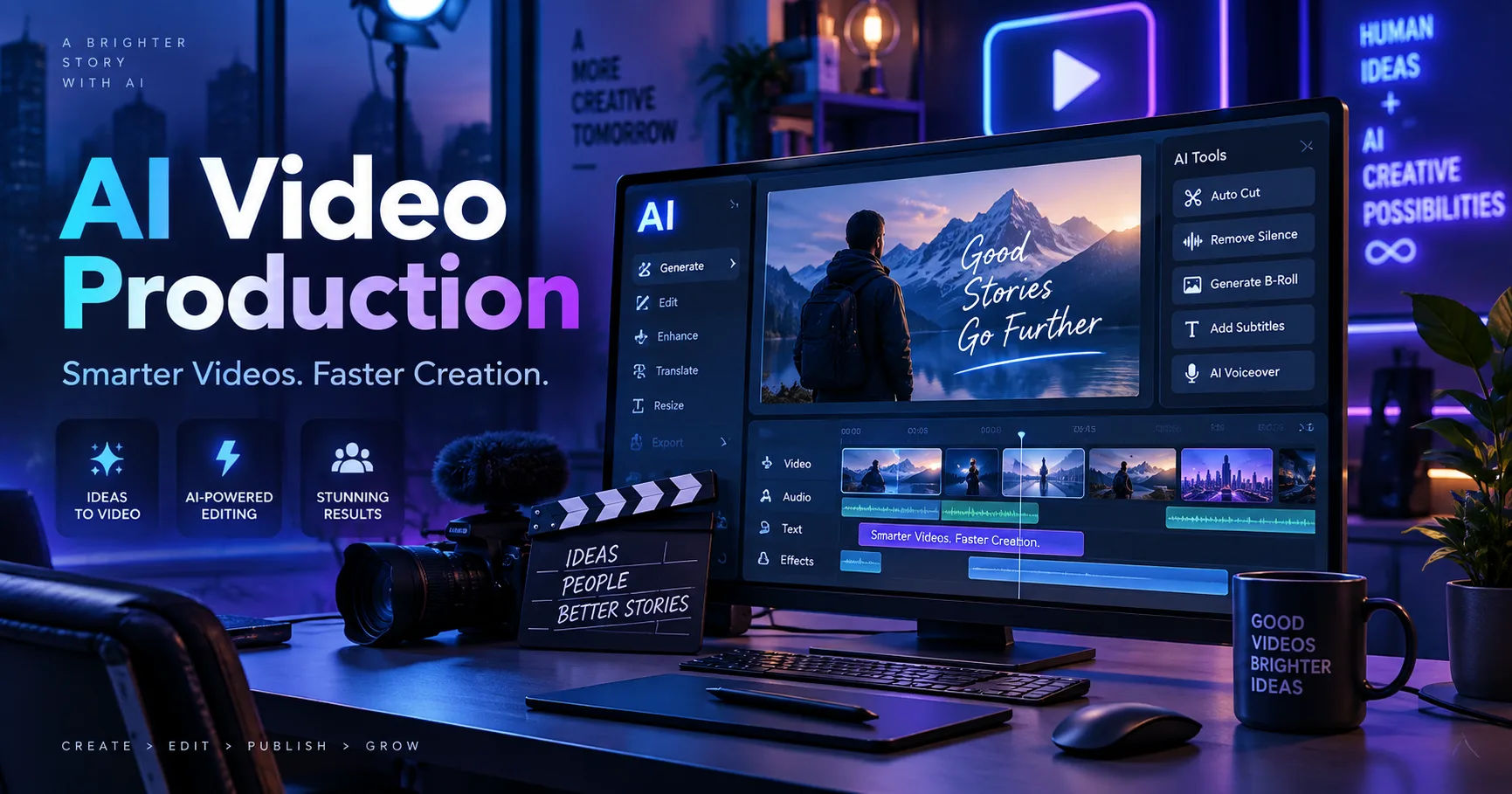
This technology has changed the way businesses, educators, marketers, social media creators, and individuals approach video creation. A process that once required cameras, actors, editors, voice artists, and specialized software can now be completed with a combination of AI-powered tools and human creativity.
Understanding how the process works can help you decide where AI is useful and where human input remains important.
What Is AI Video Production?
AI video production refers to creating or editing video content with the assistance of artificial intelligence. AI systems analyze text, images, audio, video, and other information to perform tasks that traditionally required manual work.
For example, a user can provide a written description such as, “Create a short video explaining how solar panels work.” An AI platform may turn that description into a script, suggest scenes, generate visuals, create narration, and arrange the material into a video.
The exact capabilities depend on the software being used. Some platforms focus on text-to-video generation, while others specialize in AI avatars, voice generation, editing, animation, or video enhancement.
How Does AI Video Production Work?
The process usually involves several stages. Although different platforms use different workflows, the basic process remains similar.
1. Starting With an Idea
Every video begins with an idea. The creator first decides what the video should communicate and who should watch it.
For example, a company might want to create a product demonstration. A teacher might need an educational video. A social media creator could want a short video explaining a popular topic.
The clearer the objective, audience, tone, and desired length are, the easier it becomes to create useful content with AI.
2. Creating the Script
The next stage is usually script development.
AI writing systems can help transform a basic idea into an organized script. The creator can provide information about the subject, target audience, tone, length, and format.
For example, a request could ask for a two-minute educational script written for high school students. The AI can then produce an introduction, main explanation, examples, and conclusion.
Human review is still important because AI-generated scripts can contain inaccurate information, repetitive language, or statements that need additional context.
3. Generating or Collecting Visuals
Once the script is ready, the production process moves toward visuals.
AI tools can generate images and video clips from text descriptions. A creator might describe a futuristic city, a product demonstration, a historical setting, or an animated character.
Some systems generate completely new video scenes, while others help select existing stock footage or organize uploaded material.
The quality of generated visuals depends on the AI model, prompt, source material, and technical settings.
4. Creating AI Voiceovers
Voice narration is another important part of modern video creation.
AI voice technology can convert written scripts into spoken audio. Many systems provide different voices, languages, accents, speaking styles, and speeds.
A creator can generate narration without recording their own voice. This can be useful for educational videos, product explainers, tutorials, and other formats where narration is more important than showing a presenter.
However, natural communication requires more than accurate pronunciation. Pauses, emphasis, emotion, and pacing can affect how convincing a voice sounds.
The Role of AI Avatars
AI avatars allow a digital presenter to appear on screen and deliver a prepared script.
The creator typically chooses an avatar, enters or uploads a script, selects a voice, and generates the video.
This approach is particularly useful for training materials, corporate communication, educational presentations, and informational content.
AI avatars can reduce the need for cameras, lighting equipment, studios, and repeated recording sessions.
At the same time, creators should consider whether an avatar fits the purpose of the video. Some audiences may prefer a real person, particularly when authenticity and personal connection are important.
How AI Editing Works
Video editing can be one of the most time-consuming parts of production. AI can automate several editing tasks.
Automatic Scene Selection
AI systems can analyze footage and identify potentially useful scenes. They may detect people, objects, speech, movement, or changes in the scene.
This can help editors find relevant clips faster instead of reviewing every second manually.
Automatic Captions
AI speech-recognition technology can convert spoken words into written captions.
This makes videos more accessible and can also help viewers understand content when they are watching without sound.
Creators can usually review and correct captions before publishing because automatic transcription may misunderstand names, technical terms, accents, or background speech.
Removing Unwanted Content
Some AI editing tools can identify silence, repeated sections, unwanted background noise, or other material that does not contribute to the final video.
This can speed up the editing process, especially when working with long recordings.
Improving Audio and Video Quality
AI can also help enhance video and audio.
For example, an AI-powered system may reduce background noise, improve speech clarity, stabilize footage, upscale lower-resolution video, or adjust certain visual elements.
These features can be especially helpful when the original recording was made in less-than-ideal conditions.
How Text-to-Video Technology Works
Text-to-video systems are one of the most visible developments in AI video creation.
The user provides a written prompt describing what should appear in a video. The AI interprets the language and attempts to generate visual content that matches the description.
For example, a prompt might describe a cinematic view of a busy city street during rainfall. The system processes the words and generates a sequence designed around those instructions.
Behind the scenes, advanced machine-learning models have been trained on large collections of visual and textual information. They learn relationships between language and visual patterns.
The result is not simply a video being copied from a database. The model generates content based on patterns learned during training and the instructions provided by the user.
Why Prompts Matter
Prompts are important because AI systems depend heavily on instructions.
A vague prompt might produce a result that does not match the creator's expectations.
A more detailed prompt can describe the subject, environment, camera movement, lighting, visual style, mood, action, and duration.
For example, instead of saying:
“Show a car.”
A more specific instruction might describe a modern electric car driving through a city at sunset, with a slow cinematic camera movement and realistic lighting.
The exact results will vary between platforms, but detailed instructions generally give the system more information about the intended outcome.
Human Creativity Still Matters
Although AI can automate many production tasks, it does not eliminate the need for human involvement.
A successful video still requires decisions about the purpose, message, audience, storytelling, pacing, and overall quality.
AI may generate several possible scenes, but a human can decide which scenes actually support the story.
Human review is also important for factual accuracy, cultural context, brand consistency, copyright considerations, and appropriate use of generated material.
In practice, AI works best as a production assistant rather than a complete replacement for creative judgment.
Benefits of AI Video Production
There are several reasons businesses and creators are adopting AI-based video workflows.
Faster Production
AI can automate repetitive tasks and reduce the time required to create certain types of videos.
Generating captions, creating voiceovers, organizing footage, and producing initial edits can often happen much faster than completing each task manually.
Lower Production Requirements
Traditional video production can require cameras, microphones, lighting, locations, actors, editors, and other resources.
AI can reduce the number of resources required for some projects.
This does not mean every professional production becomes inexpensive. High-quality videos can still require experienced people, specialized equipment, and extensive post-production.
Easy Content Adaptation
AI makes it easier to adapt existing content into different formats.
For example, a long educational video could be transformed into several shorter clips. A written article could become a narrated video. A presentation could be converted into an animated explanation.
This can help organizations create content for multiple platforms.
Multilingual Content
AI translation and voice technologies can help creators produce videos in multiple languages.
A single script can potentially be translated and paired with different voiceovers.
Human review remains important, particularly when cultural expressions, technical terminology, or regional language differences matter.
Common Uses of AI Video Production
AI-generated and AI-assisted videos are used across many industries.
Marketing
Businesses can create product demonstrations, advertisements, social media videos, promotional explainers, and personalized content.
Education
Teachers and educational organizations can use AI to create lessons, visual explanations, tutorials, and revision materials.
Social Media
Creators can produce short-form videos for platforms such as TikTok, Instagram, YouTube, and other social networks.
Corporate Training
Companies can develop employee training materials using AI presenters, narration, captions, and visual demonstrations.
Customer Support
Businesses can create instructional videos explaining how to use products or solve common problems.
Challenges and Limitations
Despite its advantages, AI video creation has limitations.
Inconsistent Results
Generated videos may contain visual errors, unnatural movements, strange object interactions, or inconsistencies between scenes.
AI-generated characters may also change appearance between shots unless the production system provides strong character consistency.
Accuracy Problems
AI can produce incorrect information. This is particularly important when creating educational, scientific, medical, financial, or news-related content.
Information should be checked against reliable sources before publication.
Copyright and Ownership Questions
The legal treatment of AI-generated content can vary depending on the country, platform, source material, and circumstances of creation.
Creators should understand the terms of the tools they use and make sure that their source materials and generated content are appropriate for their intended use.
Lack of Human Emotion
AI can simulate certain emotional qualities, but storytelling often depends on experiences, cultural understanding, personal expression, and subtle communication.
For emotionally sensitive projects, human direction can remain particularly important.
A Typical AI Video Workflow
A practical workflow might begin with research and planning. The creator defines the audience and purpose before preparing a script.
The script is then reviewed and divided into scenes. Visuals can be generated or selected for each section.
Next, narration is created and synchronized with the visuals. Captions, music, transitions, and other elements are added during editing.
The creator then watches the complete video and checks the facts, pronunciation, timing, visuals, branding, and audio quality.
Finally, the video is exported in the appropriate resolution and format for its intended platform.
This workflow shows that AI does not necessarily replace the entire production process. Instead, it connects several automated tools into a more efficient creative workflow.
How to Get Better Results
Good planning can significantly improve the final product.
Start with a clear objective rather than immediately generating random scenes. Decide what viewers should learn, feel, or understand after watching.
Keep the script focused. Shorter sentences can make narration easier to follow.
Use detailed prompts for generated visuals and maintain consistent descriptions of important characters, locations, products, and visual styles.
Always review the final result. Watch the entire video instead of assuming that an automated system produced everything correctly.
It is also useful to create several versions when the first result does not meet expectations. AI generation is often an iterative process.
The Future of AI Video Production
AI video technology continues to develop rapidly. Future systems are likely to provide more control over characters, camera movement, environments, editing, sound, and storytelling.
The relationship between human creators and AI tools may therefore become more collaborative.
Instead of manually performing every technical step, creators may spend more time developing ideas, directing scenes, checking accuracy, and shaping the final story.
As technology improves, understanding how to give precise instructions and evaluate generated material will become increasingly valuable.
Conclusion
AI video production combines artificial intelligence with traditional creative processes to make video creation faster and more accessible. AI can assist with scripting, visual generation, voiceovers, avatars, editing, captions, translation, and enhancement.
The process generally begins with an idea and script, followed by visual and audio creation. AI tools can then assemble and edit these elements into a finished video.
However, automation does not guarantee quality. Human creativity, fact-checking, editing, storytelling, and judgment remain important throughout the process.
For businesses, educators, marketers, and creators, the greatest value may come from using AI to handle repetitive production work while allowing people to focus on the ideas and decisions that shape the final video.